
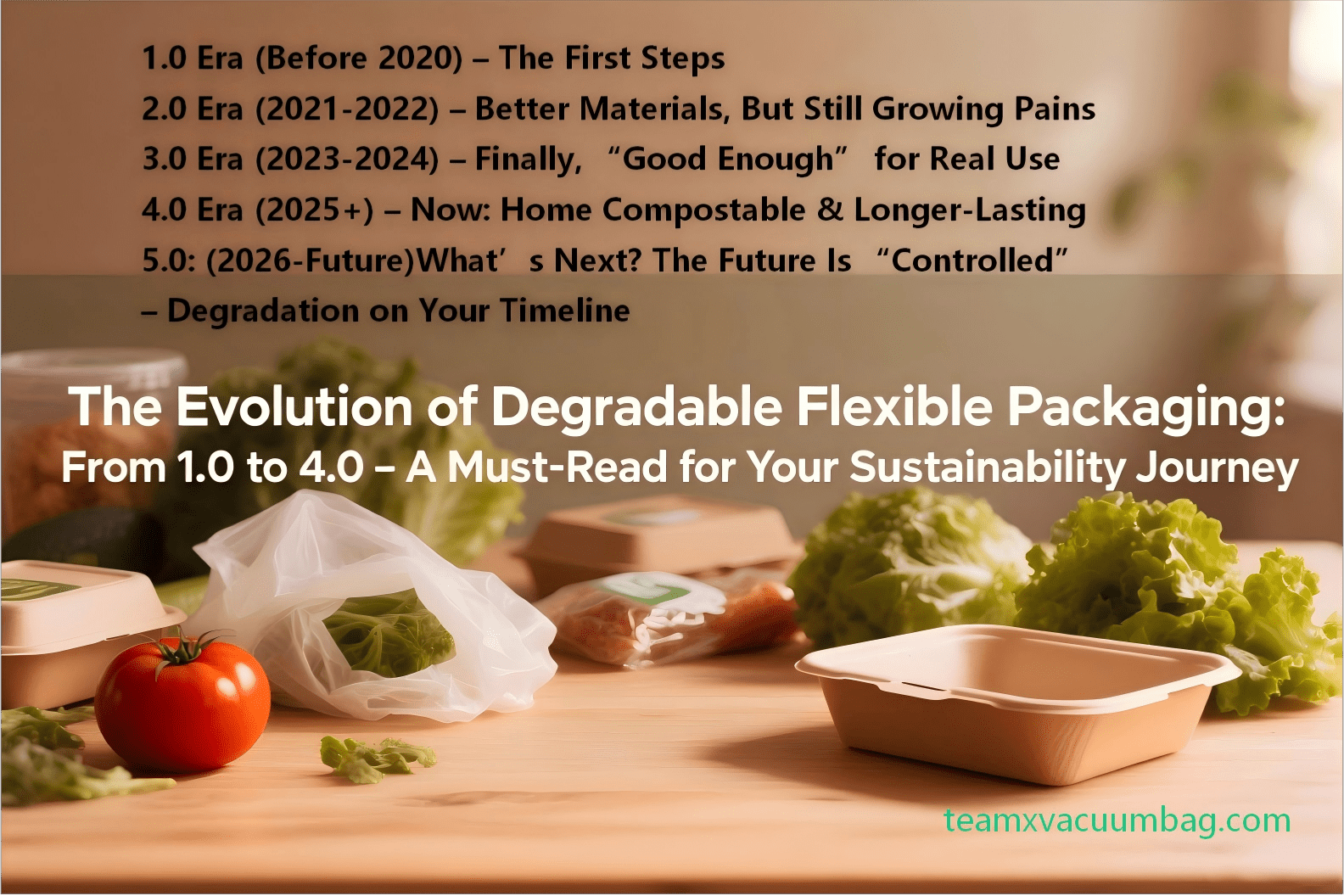
The 1.0 Era (Before 2020) – The First Steps
The 2.0 Era (2021-2022) – Better Materials, But Still Growing Pains
The 3.0 Era (2023-2024) – Finally, “Good Enough” for Real Use
The 4.0 Era (2025+) – Home Compostable & Longer-Lasting
The 5.0: What’s Next? The Future Is “Controlled” – Degradation on Your Timeline

Degradable packaging didn’t start perfect – it started with curiosity, trial, and a lot of learning. Here’s how it’s evolved, and why today’s solutions are so exciting for businesses like yours.

The 1.0 Era (Before 2020) – The First Steps
Back then, “degradable flexible packaging” was more of an idea than a reality. Most early attempts came from companies that made regular shopping bags, not experts in food-grade or high-performance packaging.
- What they used: Without special films, they used simple single-layer machines. They added things like baking soda (calcium carbonate) or corn starch to cut costs. This made the film thin, weak, and easy to tear.
- The limits: These films only lasted about 6 months. Bio Garbage bags and supermarket shopping bags need replacing every 3-6 months. Worse, they couldn’t safely touch food because of the fillers. This meant they had to say “not for food.” This ruled them out for packaging things like coffee or snacks, which need to last 12-18 months, even during long shipping trips.
The 2.0 Era (2021-2022) – Better Materials, But Still Growing Pains
As more people wanted sustainable packaging, companies tried using “purer” degradable materials – but there were still hiccups.
- What changed: They stopped using cheap fillers, but stuck with old machines (single-screw extruders). This caused the film to break down too fast when layered with other materials. It did not meet food-safety standards.
- The ups and downs: Shelf life improved to 9-12 months – good enough for simple items (like basic household goods). But small issues added up: zippers still had baking soda, so coffee bags’ zippers would get brittle after a few months (we heard lots of complaints about that!).
- How it felt for you: Even though 2021-2022 had a lot of excitement about sustainability, the flaws of 1.0 and 2.0 left many of you thinking, “degradable flexible Packaging just isn’t reliable enough” – especially when you needed it to last 18-24 months for food or premium products.
The 3.0 Era (2023-2024) – Finally, “Good Enough” for Real Use
In 2023, we introduced our 3rd-gen degradable films – a big leap forward, thanks to multi-layer film-making technology. This was the moment we moved from “experimenting” to “delivering real solutions.”
- How we did it: We used 4-layer film-making machines. We built films with specific layers like a “seal layer” for strength and a “barrier layer” to keep out air/moisture. Each layer was designed to work perfectly together. The result? Films that are stronger, clearer, and more durable than ever.
- The proof is in the numbers:
- Moisture resistance (OTR,cm³/(m²·day·atm)): Dropped from 180 (1.0/2.0) to 60 (now) – getting close to traditional PE plastic (18).
- Oxygen resistance (WVTR,g/(m²·24h)): Reached 300-2000 (now) – matching materials like PET (150), PP (2000), and PE (2000-6000).
- Peace of mind: We tested every batch with top-quality tools (tensile testers, seal checkers, etc.) to make sure they’re reliable – no surprises, just consistent quality.
The 4.0 Era (2025+) – Taking It Further: Home Compostable & Longer-Lasting
In 2025, we took it up a notch with our 4th-gen packaging. We solved two big issues: where it breaks down and how well it protects.
- Breaking down at home: Now, our films don’t need industrial composting facilities – they’ll degrade in your backyard compost pile (much easier for everyone!).
- Even better protection: Moisture resistance(OTR) is now 10-15 (super close to PE’s 18). Oxygen resistance(WVTR) is 200-300. This makes it perfect for food packaging, where balancing “breath ability” and “protection” is tricky.
- More than just film: We’ve made home-compostable zippers and vents. They are all tested to last long enough for your products. This is the case no matter how they’re used.
The 5.0 Era (2026+)What’s Next? The Future Is “Controlled” – Degradation on Your Timeline
We’re not stopping here. Here’s what we’re working on:
- Mastery across the board: From raw materials to finished films, we’re investing in every step. We aim to offer you not just a product, but a partner that helps you solve problems.
- Even better performance (2025-2027): By 2027, we aim to make films with moisture resistance(OTR) as low as 5 – matching PP plastic (the gold standard for many uses)
- Degradation on demand: Imagine packaging that breaks down when you want it to. It degrades in 3 months for short-life items and in 3 years for long-life products. The packaging then safely turns into water, CO₂, and plant food. That’s the future we’re building.
Why This Should Matter to You
This journey from 1.0 to 4.0 isn’t just about technology – it’s about solving your challenges. Early films couldn’t keep food fresh or last long enough; today, our 4.0 solutions deliver the reliability, performance, and sustainability you need.
There are now industrial and household smart composting machines on the market that can easily decompose degradable flexible packaging within 24 hours. This link will become more and more mature.
Yes, we’ve only tackled 1% of the plastic waste problem (most ocean plastic still comes from old, non-degradable stuff). But every step forward brings us closer to a world where packaging doesn’t harm the planet.
By choosing to work with us, you’re not just picking a material. You’re investing in a partnership that cares about both the earth and your business.
I’d love to chat more about how these advancements can help you specifically. Whether you’re looking to refresh your packaging, hit new sustainability goals, or future-proof your supply chain, this story provides clarity. It helps you make choices that feel right.
Looking ahead to hearing your thoughts – and to continuing this journey toward a greener, brighter future together.